العربية
 فارسی
فارسی हिन्दी
 Русский
 Türkçe
Published on • Updated:
Grinding Machines and Types of Grinding Machines
A complete guide to grinding machines including surface grinding, cylindrical grinding, centerless grinding, internal grinding, crankshaft grinding, tool grinders, and CNC grinding. Learn about their features, applications, and real-world industrial examples.
Grinding machines are essential in metalworking and mechanical engineering industries. By using abrasive wheels, they perform precise material removal and achieve superior surface finishes with very low roughness (Ra).
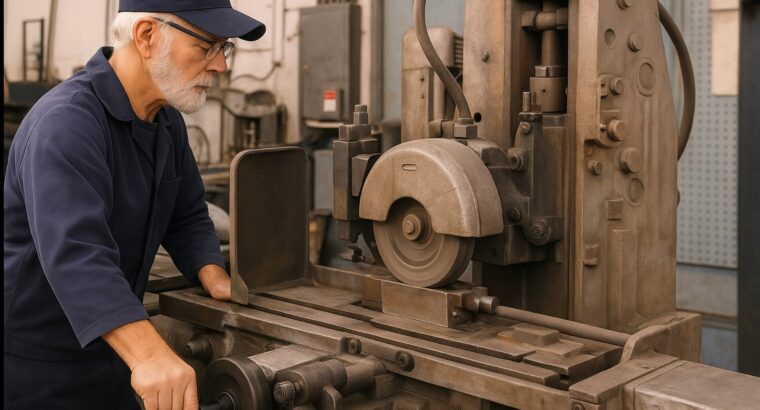
1) Surface Grinding Machine
Used for flat surfaces, surface grinders provide precise and smooth finishing. The table can be rectangular or rotary, ensuring uniform material removal.
Features
- Very smooth surface finish (low Ra)
- High dimensional accuracy in flatness and thickness
- Usable for steel, alloy, and tool materials
Applications & Examples
- Mold plates for plastic injection and die-casting
- Shear blades and sheet metal cutting tools
- Surface preparation before plating or coating
- Fixture plates and guide components

2) Cylindrical Grinding Machine
Designed for grinding external or internal cylindrical surfaces. The workpiece is usually mounted between centers for high concentricity.
Features
- Perfect for shafts, rolls, and journals
- Can grind parallel or angular surfaces
- Available as manual, semi-automatic, or CNC
Applications & Examples
- Grinding engine and gearbox shafts
- Printing and rolling mill rollers
- Industrial machine cylinders
3) Centerless Grinding Machine
Here, the workpiece is placed between the grinding wheel and a regulating wheel, eliminating the need for centers. Ideal for high-volume production of constant diameters.
Features
- Extremely high production speed
- Excellent for small, precise parts
- Consistency in mass production
Applications & Examples
- Pins, bushes, precision rods
- Automotive parts like valves and injector needles
- Bearings and industrial rollers
4) Internal Grinding Machine
Used for grinding internal surfaces or bores with small-diameter wheels. Essential for hardened components with strict dimensional tolerances.
Features
- High precision in bore diameters
- Excellent concentricity and surface finish
- Ideal for hardened workpieces
Applications & Examples
- Bearings and precision bushings
- Small hydraulic cylinders
- Medical parts with fine bores
5) Crankshaft Grinding Machine
Specifically designed to grind and refurbish crankshafts of cars, trucks, and heavy machinery. Restores journals and pins to exact dimensions.
Features
- Special fixtures for crankshaft curves
- Accurate alignment of journals
- Extends crankshaft service life
Applications & Examples
- Refurbishing car and truck crankshafts
- Repair of tractor and construction machinery crankshafts
6) Tool Grinder
Designed to sharpen and recondition cutting tools like drills, milling cutters, taps, reamers, and saw blades, reducing tooling costs significantly.
Features
- Adjustable angles and profiles
- Suitable for HSS and carbide tools
- Extends tool life and cutting quality
Applications & Examples
- Sharpening CNC inserts and drills
- Regrinding milling cutters and saw blades
- Refurbishing taps and reamers
7) CNC Grinding Machine
With numerical control, CNC grinders can produce complex shapes with micron-level tolerances. Used in aerospace, medical, and advanced automotive industries.
Features
- Ultra-high accuracy and repeatability
- Automated programming for serial production
- Capability for complex forms and profiles
Applications & Examples
- Surgical instruments and implants
- Engine and turbine components
- Complex molds for plastics and die casting
Key Factors in Choosing a Grinding Machine
- Workpiece type: flat, cylindrical, bored, or profiled
- Required precision: surface finish, concentricity, roundness
- Production volume: single-part, batch, or mass production
- Control type: manual, semi-automatic, or CNC
- Maintenance: access to wheels, coolant, and spare parts
Frequently Asked Questions
What is the difference between cylindrical and centerless grinding?
In cylindrical grinding, the workpiece is held between centers and is ideal for shafts and rollers. In centerless grinding, the workpiece is held between two wheels, making it excellent for high-volume, consistent-diameter parts.
When should CNC grinding be used?
When micron-level tolerances, repeatability, or complex profiles are required (e.g., aerospace and medical parts).
What is the role of coolant in grinding?
Coolant reduces heat, improves surface finish, prevents burns, and extends wheel life.
Buy & Sell Grinding Machines
If you are looking to buy or sell grinding machines, explore related listings on nikgi.com or post your own ad today.