العربية
 فارسی
فارسی हिन्दी
 Русский
 Türkçe
Published on • Updated:
Press Machines and Their Types: Complete Guide
A detailed guide to press machines: mechanical, hydraulic, pneumatic, impact, forging (hot/cold), manual, CNC, screw, knuckle joint, toggle, single/double crank, and high-speed presses — with advantages, uses, and selection tips.
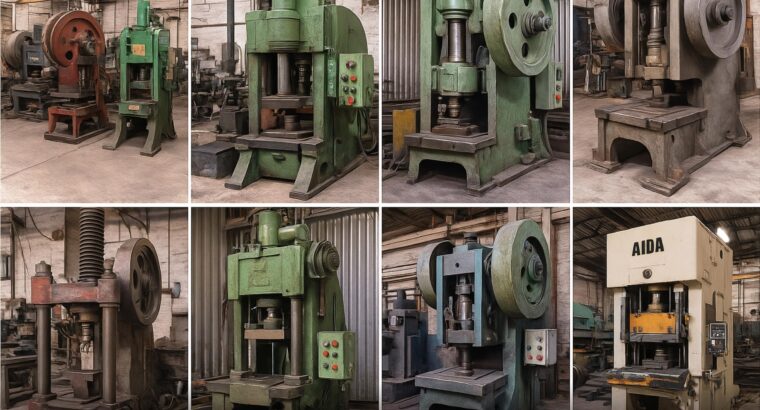
Press machines are among the most important industrial machines in sheet metal forming, cutting, punching, bending, deep drawing, and forging. Depending on their mechanism, they may be mechanical, hydraulic, pneumatic, or a combination. Choosing the right press directly impacts product quality, production speed, and overall cost.
General Classification of Presses
- By power source: Mechanical, Hydraulic, Pneumatic
- By mechanism: Screw, Knuckle joint, Toggle
- By crank design: Single crank, Double crank
- By forging temperature: Hot forging, Cold forging
- By automation: Manual, Semi-automatic, CNC
- By speed: High-speed presses
1) Mechanical Press
Uses flywheel and crankshaft to convert rotary motion into linear; suitable for mass production.
- Applications: punching, cutting, progressive die forming
2) Hydraulic Press
Operates with hydraulic cylinders; provides uniform pressure throughout the stroke.
- Applications: deep drawing, heavy bending, forming thick materials
3) Pneumatic Press
Powered by compressed air; fast and economical for light-duty tasks.
- Applications: assembly, light riveting, electronics, packaging
4) Impact Press
Applies high energy in a short stroke; efficient for instantaneous operations.
- Applications: riveting, fast punching, marking
5) Forging Press (Hot and Cold)
5.1 Hot Forging
- Above recrystallization temperature (~900–1250°C for steel)
- Applications: crankshafts, gears, heavy-duty tools
5.2 Cold Forging
- At room temperature or slightly above
- Applications: bolts, nuts, rivets, bushings
6) Manual Press
Hand-operated; low-cost and suitable for small workshops.
7) CNC Press
Numerically controlled; offers high precision, repeatability, and reduced waste.
8) Screw Press
Force applied through a large screw; provides excellent control of stroke and force.
9) Knuckle Joint Press
Uses knuckle-lever mechanism; maximum force at end of stroke.
- Applications: nuts, bolts, small precision components
10) Toggle Press
Toggle linkages increase force at the end of stroke; economical and good for light work.
11) Single & Double Crank Press
Single Crank
- Simple and fast; best for small to medium parts
Double Crank
- Distributes force evenly; suitable for large sheet metal parts (e.g. automotive body)
12) High Speed Press
Optimized mechanical presses designed for mass production at 150–1000+ strokes per minute (SPM). Equipped with lightweight flywheels, precision bearings, lubrication and cooling systems, and automatic feeding.
- Advantages: high productivity, reduced cost per unit
- Limitations: best for thin sheets, requires higher investment
- Applications: electronics, connectors, washers, bolts, automotive small parts
Selection Criteria
- Process type: cutting, punching, bending, deep drawing, forging
- Material and thickness
- Production volume
- Required precision and surface finish
- Safety and standards compliance
- Cost of operation and maintenance
Industrial Applications
- Automotive: body panels, subframes
- Home appliances: washing machine, refrigerator panels
- Aerospace/Rail: structural panels
- Fasteners: nuts, bolts, rivets
- Forging: gears, crankshafts, heavy tools
- Electronics: small sheet parts, connectors
FAQ
Which press is best for deep drawing?
A hydraulic press provides uniform pressure and is ideal for deep drawing processes.
Difference between single and double crank presses?
Single crank is simpler and faster for small/medium parts; double crank provides better force distribution for large sheet metal components.
What are high-speed presses used for?
They are used for thin sheet parts in mass production such as connectors, washers, small automotive or electronic parts.
Buy and Sell Press Machines
If you want to buy or sell a press machine, check listings on nikgi.com or post your ad today.